
The geometry
A regulation tennis court has playing lines of 78 by 36 feet inside a standard footprint of 120 by 60 feet including run-off. A pickleball court's lines are 20 by 44 feet; USA Pickleball recommends a total playing surface of at least 30 by 60 feet per court and prefers 34 by 64 feet. Four pickleball courts fit a tennis footprint in a two by two layout, each with its own run-off, which is why a conversion is the fastest way for a park, club or school to add pickleball capacity.
Three ways to convert
- Blended lines. Pickleball lines added in a contrasting color on the tennis court, with portable nets. Tennis stays playable. Lowest cost, and the right answer where tennis demand is still real.
- Dedicated conversion, same slab. Tennis lines removed, the court resurfaced and striped as four pickleball courts, permanent nets set in the slab, divider fencing added. The tennis net posts come out.
- Dedicated conversion with slab work. Same as above but the existing slab is repaired, leveled or overlaid first because it had moved, cracked or delaminated.
Why rushed conversions fail
Pickleball demand arrived fast and many conversions were priced like a restripe. The City of Coppell, Texas converted two tennis courts into eight pickleball courts in 2024 at a low bid; by 2026 the courts had cracked and delaminated and the City awarded EliteTrax the repair and full resurfacing of the same eight courts, with concrete corner work and grinding back to bare concrete. The lesson is not about the first contractor; it is that a conversion sits on the same slab with the same cracks, and preparation and crack treatment decide whether it lasts.
What to plan for
- Slab assessment first. Photos, then a straightedge and a flood test outdoors. Cracks get treated the same way as on any resurface: on post-tensioned slabs we grind, fill with a two-part polyurethane crack filler and grind smooth; we never rout hairline cracks.
- Nets and posts. Permanent pickleball net posts set in the slab, not surface-mounted brackets, for a dedicated conversion.
- Divider and perimeter fencing. Four courts in one cage means balls everywhere; divider fencing between courts is part of the plan, not an add-on later.
- Orientation. USA Pickleball recommends a north-south orientation to keep the sun out of players' eyes. A tennis court is already north-south, so the four pickleball courts run the same way.
- Noise. Pickleball is louder than tennis. If the courts are near homes, plan sound-dampening fence screens before the neighbors ask.
- Surface. Standard acrylic for parks; cushioned Laykold systems for clubs and indoor facilities; VersaCourt modular tile where drainage or speed of install favors tile.
- Colors. A contrasting kitchen (non-volley zone) and court color helps players read the court. Standard colors are included in our pricing; vibrant colors carry an upcharge.
What it costs
A blended-line job is a striping job. A dedicated conversion is priced as a resurface of the tennis footprint plus nets, posts and fencing, so the public resurfacing ranges in our budget guide are the starting point, with fencing and nets on top. If the slab has moved, see resurface or rebuild. Send photos and the court count for a number for your courts.
A finished example
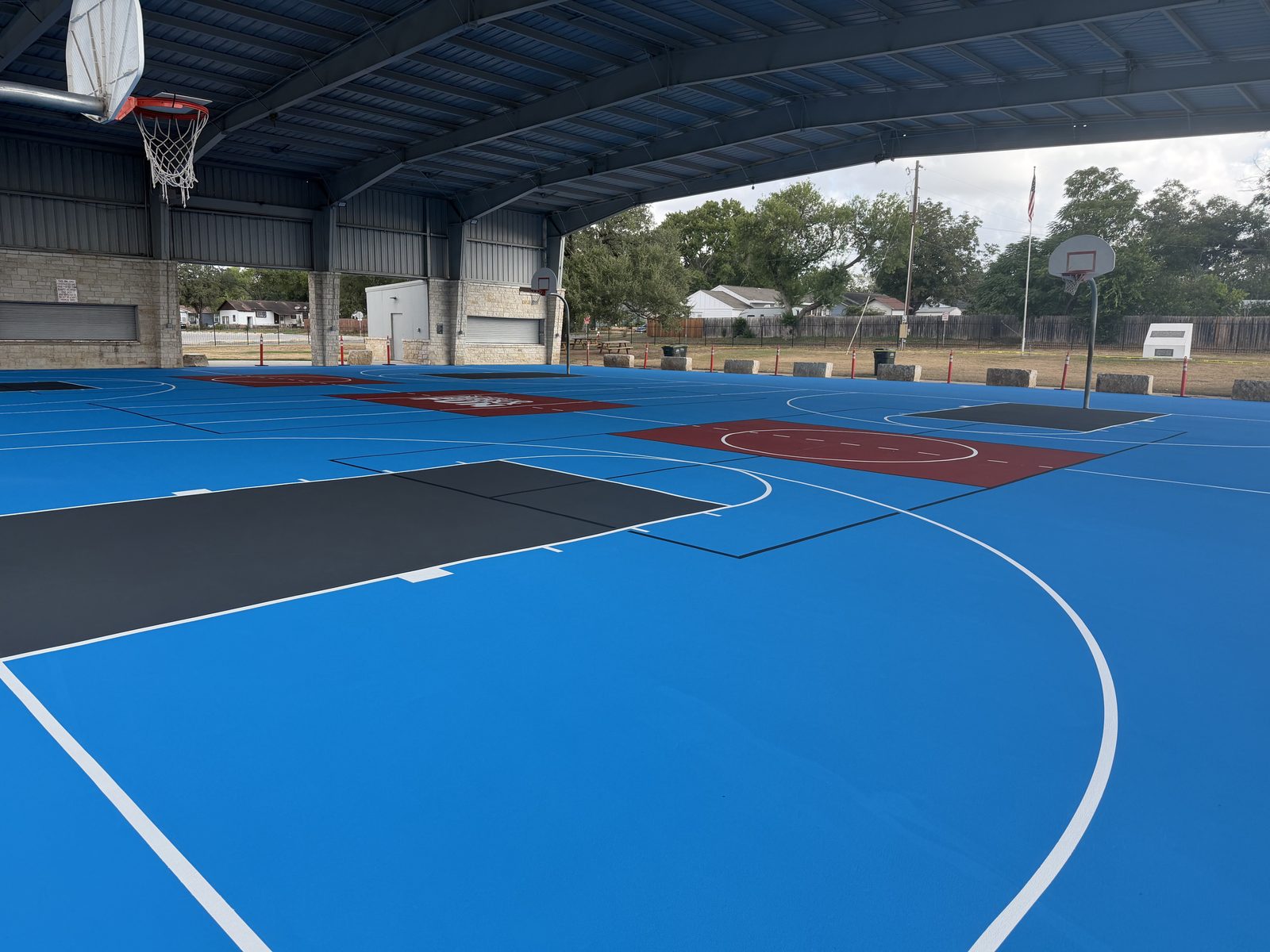
At Pickrell Park in Schertz, Texas, the City's pavilion court was resurfaced in Laykold as three pickleball courts sharing the slab with a basketball court: light blue field, brick red kitchens, dark grey keys and a custom city logo, six days on site. See the project.
Questions
Can we keep tennis and add pickleball?
Yes. Blended lines in a contrasting color with portable nets keep tennis playable. It is the lowest-cost option and reversible.
How long does a conversion take?
A dedicated conversion on a sound slab is days on site, like any resurface. Fencing and net post work add a few days. Outdoor courts are playable 24 hours after lines when nights stay above 60 degrees.
Do you install sound screens?
We include fence-mounted sound-dampening screens in the fencing scope when the site needs them. Tell us how close the neighbors are.
Sources
- USA Pickleball, outdoor court construction and dimensions: usapickleball.org.
- Coppell Chronicle, Vol. 6 No. 27, Wagon Wheel pickleball court conversion and 2026 repair award: article.
- American Sports Builders Association, Pickleball Courts: A Construction and Maintenance Manual (3rd edition), on file at EliteTrax: sportsbuilders.org.
- United States Tennis Association, court dimensions: usta.com.